

Under the Patronage of the Minister of Social Solidarity: “Field Schools” Lead Efforts to Combat the Black Cloud in Beheira
Awareness Seminars and Practical Trainings to Enhance Food Security and Promote Sustainable Agricultural Practices
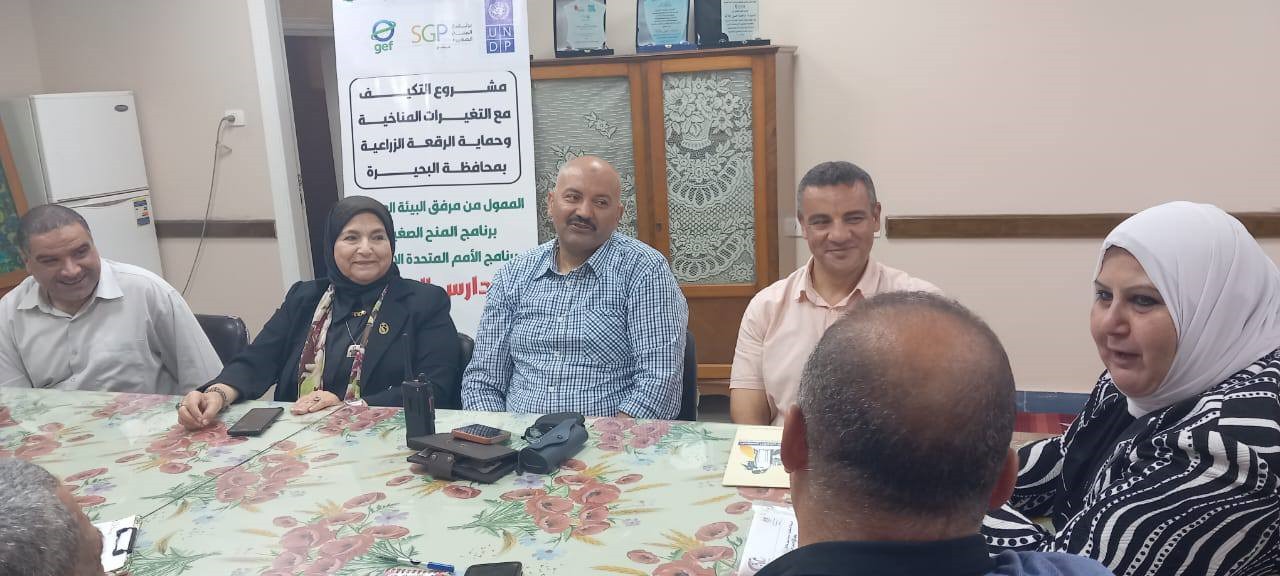
Under the patronage of Dr. Maya Morsy, Minister of Social Solidarity, and Dr. Jacqueline Azar, Governor of Beheira, and under the supervision of Dr. Magda Galala, Undersecretary of the Ministry of Social Solidarity, the coordination committee of the project “Adaptation to Climate Change and Protection of Agricultural Land”—implemented by the Egyptian Association for Local Community Development and funded by the Small Grants Programme of the Global Environment Facility (GEF/SGP)—held its meeting this week at the office of the Undersecretary of Social Solidarity. Dr. Emad El-Din Adly, National Director of the Small Grants Programme, participated via Zoom.
The meeting, which included representatives from executive and agricultural bodies in the governorate, reviewed the project’s achievements, particularly the implementation of field schools for farmers in Kafr El-Dawar and Abu Hommos. These schools have helped transfer technical expertise to address climate change impacts, improve strategic crop management, and reduce pollution caused by burning agricultural waste. Discussions also covered plans to combat the “black cloud” resulting from rice straw burning and to enhance agricultural waste recycling efforts, creating economic empowerment opportunities for rural women—thus aligning the project’s environmental and developmental goals.
At the start of the meeting, Dr. Hani Habiba, Chairman of the Association, presented the project’s key pillars, the number of farmers benefiting from the field schools, the villages involved, and the criteria for selecting strategic crops to bridge the food gap. He also discussed the agricultural waste recycling component and how it contributes to empowering rural women economically. Dr. Hosni Azzam, Undersecretary of the Ministry of Agriculture, highlighted the project’s role in disseminating agricultural guidelines to protect crops from climate change and reduce pollution from waste burning.
Dr. Magda Galala emphasized the project’s impact on improving rural families’ living standards and empowering women economically. Dr. Ali Douma, Director of the Environmental Affairs Agency in Beheira, spoke about the project’s importance in protecting the environment from pollution caused by burning agricultural waste, stressing the need to identify suitable machinery to prevent such practices and mitigate the effects of the “black cloud,” especially from rice straw.
Dr. Yasser Hegazy, Project Director, gave a detailed presentation on the activities completed so far and those planned for the future. Meeting participants praised the project’s positive outcomes, the success of the agricultural cycle, and the engagement between participating engineers and training consultants.
As part of the summer season of field schools, farmers in Abu Hommos continued receiving hands-on training in agroecosystem analysis and environmentally friendly methods for combating cotton pests. The training, conducted with agricultural consultants and extension facilitators from Kafr El-Dawar and Abu Hommos, led to the formation of a core group of local agricultural experts capable of spreading sustainable farming practices among small-scale farmers. This aligns with the project’s goal of equipping farmers with scientific tools and practical knowledge to face climate change challenges while maintaining production quality and reducing losses.
In a related effort, the Egyptian Association for Local Community Development, in cooperation with the Beheira Directorate of Agriculture, organized an awareness seminar at the Agricultural Extension Center in Qafla village, Abu Hommos. The seminar was attended by a group of experts and officials. Dr. Khairy El-Gaafari, the project’s climate change consultant, presented on the impact of climate change on Egyptian agriculture and adaptation strategies to maintain productivity and reduce losses. The seminar received strong engagement from attending farmers, who asked questions and benefited from the practical advice offered.
Through these integrated efforts, the “Adaptation to Climate Change and Protection of Agricultural Land” project continues to raise environmental awareness and offer practical solutions that combine environmental protection with rural economic support—serving as a model for sustainable agricultural development in Egypt.