

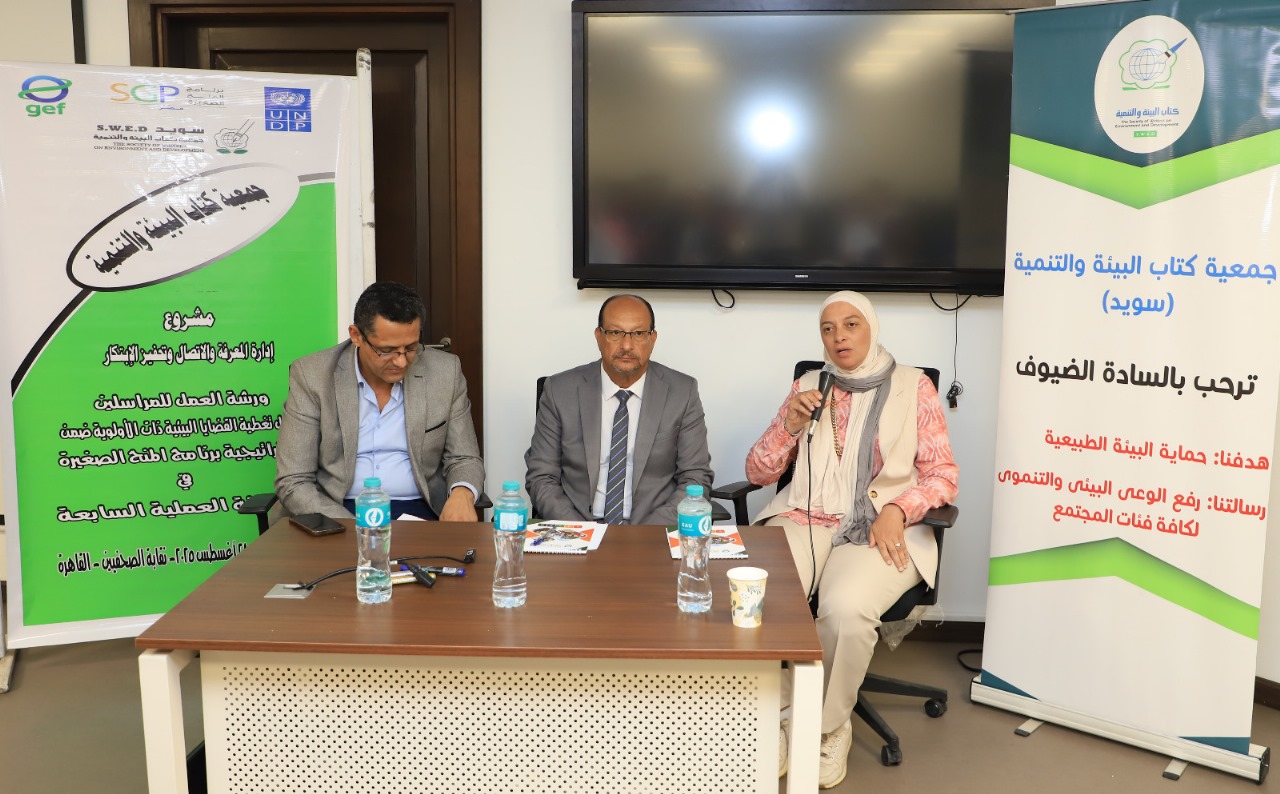
“Environmental Writers” Conclude Workshop for Reporters on Environmental Priorities of the Small Grants Programme
Late last week, the Environmental Writers and Development Association “SWED,” in collaboration with the Journalists Syndicate, concluded a consultative workshop titled “Covering Priority Environmental Issues within the Strategy of the Small Grants Programme – Phase Seven.” The workshop was held as part of the “Knowledge Management, Communication, and Innovation Stimulation” project, implemented by the association and funded by the Small Grants Programme of the Global Environment Facility (GEF/SGP) under its seventh phase in Egypt.
Held over three days at the training center of the Journalists Syndicate in Cairo, the workshop aimed to enhance the capacity of journalists and correspondents from several governorates to cover environmental issues with depth and professionalism. It focused on topics such as climate change, biodiversity, and land degradation, aligning with Egypt’s sustainable development goals. The workshop also sought to strengthen partnerships between media outlets and civil society organizations in addressing priority environmental issues under the Small Grants Programme, while promoting the media’s role in raising environmental awareness and simplifying complex challenges for the public.
The workshop welcomed 25 correspondents from Alexandria, Beheira, Fayoum, Qena, and Luxor—governorates where phase seven projects are being implemented—alongside journalists from Cairo and Giza. The opening session featured prominent attendees including journalist Khaled El-Balshy, head of the Journalists Syndicate; Dr. Ghada Ahmedin, Assistant National Director of the Small Grants Programme; and Dr. Mahmoud Bakr, President of the Environmental Writers and Development Association, along with a group of environmental journalism experts.
Over the three days, the sessions covered several key themes. Day one introduced the operational mechanisms of the Small Grants Programme in Egypt under the slogan “Think Globally, Act Locally,” and presented the 27 ongoing projects implemented by various NGOs. Discussions also explored the role of artificial intelligence in environmental journalism and concluded with a specialized session on sustainable agriculture and biodiversity, led by Dr. Ayman Farid Abou Hadid, former Minister of Agriculture and board member of the Egyptian Sustainable Development Forum.
Day two focused on renewable energy and water resource management, featuring interactive sessions between experts and journalists, moderated by Engineer Ayman Heiba, Head of the Sustainable Development Division at the Cairo Chamber of Commerce. Day three was dedicated to integrated waste management, pollution reduction, and recycling, with a discussion led by Dr. Omayma Sawan, Waste Management Consultant at the Ministry of Environment. Topics included implementing the single-use plastic bag law and addressing land degradation challenges. The final day also introduced new media initiatives for partnering with civil society to expand environmental awareness in target governorates.
During the closing session, Dr. Mahmoud Bakr, along with the Knowledge Management project team and members of the association’s board, honored the participating journalists for their contributions. The session also announced the launch of an environmental media competition for journalists working in the geographic regions targeted by phase seven of the Small Grants Programme. These regions include West Delta (Alexandria and Beheira), South Upper Egypt (Qena and Luxor), and Fayoum. The competition focuses on the role of NGOs in implementing environmental projects funded by the programme and their impact on ecosystem protection and improving local livelihoods.
Journalist Mahmoud El-Eisawy, Director of the Knowledge Management Project, stated that the organizing committee set several conditions for participation. Chief among them is that submitted journalistic works must have been published in recognized media outlets between September 1 and December 31, 2025, and must address one or more of the environmental projects being implemented in the target governorates. Eligible submissions include written reports, investigative pieces, and audiovisual materials, provided they are original and have not been submitted to other competitions.
He added that the association has allocated three financial prizes for each geographic region: EGP 8,000 for first place, EGP 6,000 for second, and EGP 4,000 for third. Entries will be accepted until January 15, 2026, and must be submitted via the designated email (swed.egypt2025@gmail.com), along with personal and professional details, a copy of the published work, and a publication link if available.
Organizers emphasized that this initiative marks the beginning of a strategic partnership between media and civil society aimed at enhancing public awareness of environmental issues and connecting them directly to citizens’ daily lives. Through real-life stories, the initiative highlights the impact of small-scale projects in protecting natural resources and improving living standards. Participants viewed the media competition as a practical step to encourage journalists to actively shape a new environmental narrative that reflects the priorities of phase seven of the Small Grants Programme and paves the way for broader environmental awareness and sustainable development across Egypt.